
Presentation at Tabernacle goes over findings, recommendations for future of entire boardwalk
OCEAN CITY — If there’s a short take on the Boardwalk Subcommittee presentation Friday night, it’s this: Eustace Mita’s big hotel project is not going to fly.
The key word of the evening on that hotel was “compromise.”
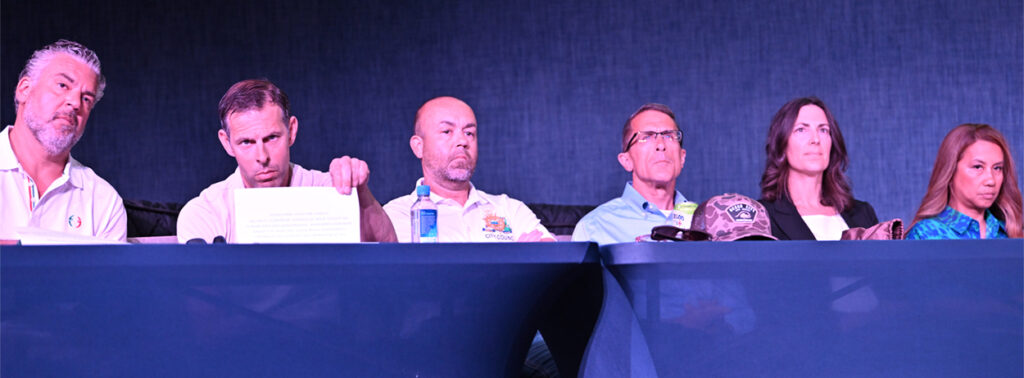
In just about 70 minutes in front of a decent-sized crowd at the Ocean City Tabernacle, the nine-member subcommittee, appointed by City Council President Terry Crowley Jr., presented its 85-page report.
The majority of the report includes the extensive research the subcommittee completed over more than seven months and the recommendations about zoning and the overall future of Ocean City’s iconic boardwalk, a year-round popular destination for locals and tourists alike.
The most anticipated part of the report was about what is going to happen with the property at 600 Boardwalk, where Wonderland Pier amusement park operated for nearly 60 years until it closed in mid-October 2024.
The rides have been silent since then, leading to a slowdown for many of the businesses on the north end of the business district. The future of the parcel has been a controversial topic at numerous board meetings, many filled with hours of public comment.
During a 12-minute introduction by member Jocelyn Palaganas, designated as spokesperson, she made it clear neither Crowley nor Mayor Jay Gillian had any involvement with the committee, allowing it to work “autonomously without outside influence to focus purely on what is best for the long-term success of Ocean City.”
She also made it clear the report would not offer a position on whether that property deserved a designation “in need of rehabilitation,” something Mita wanted as key to allowing him to build a hotel in a zone that doesn’t allow one. He has so far been denied that.
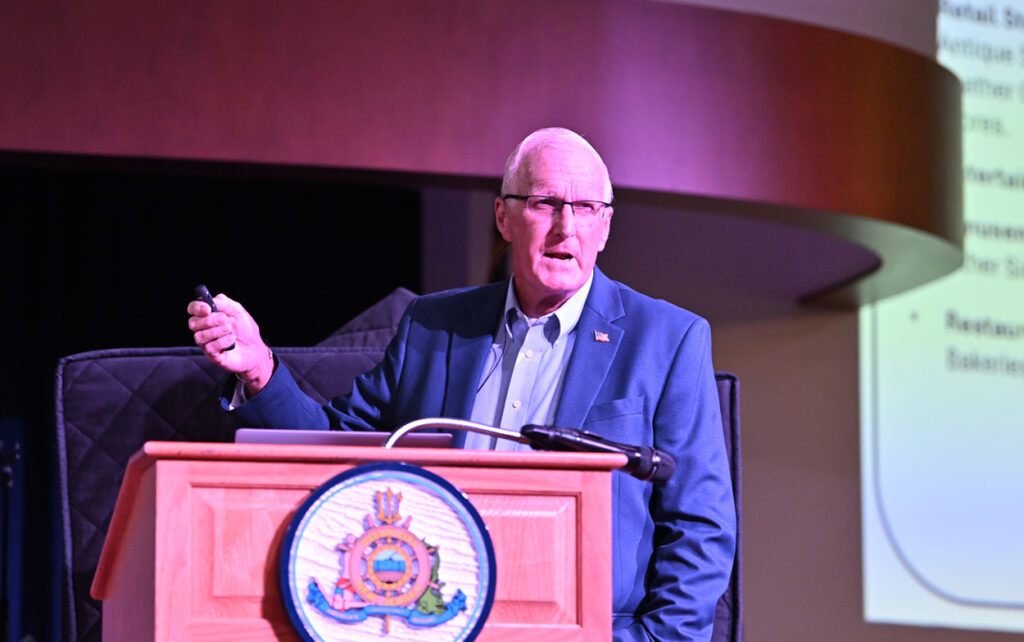
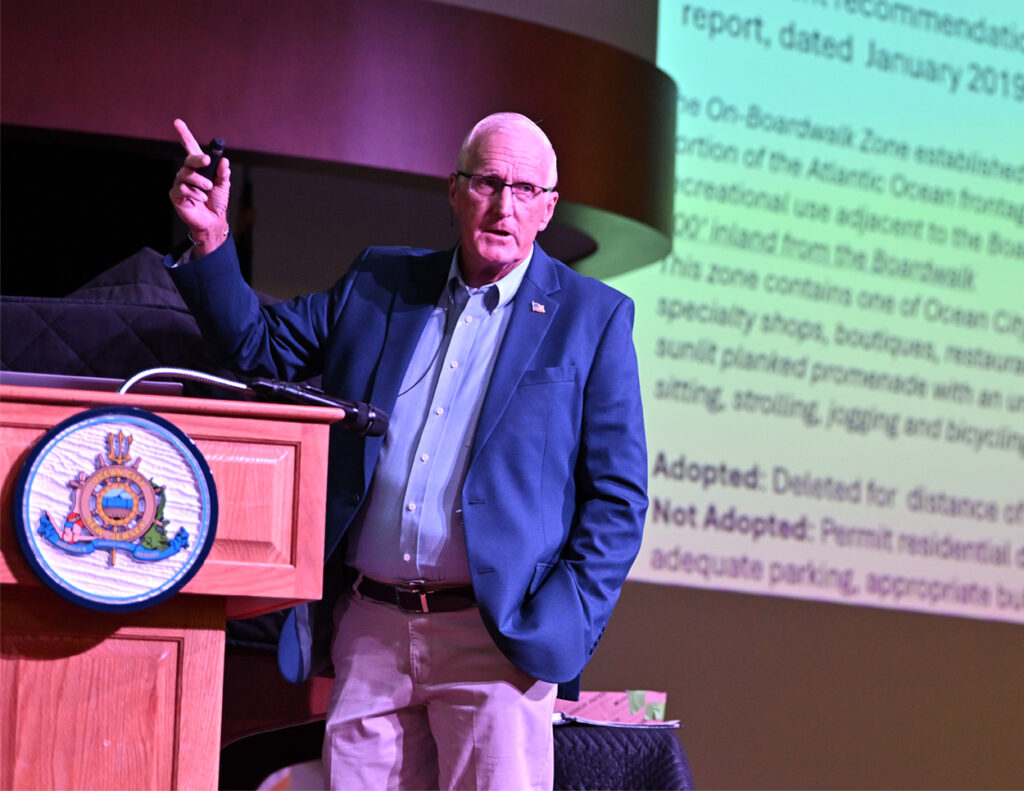
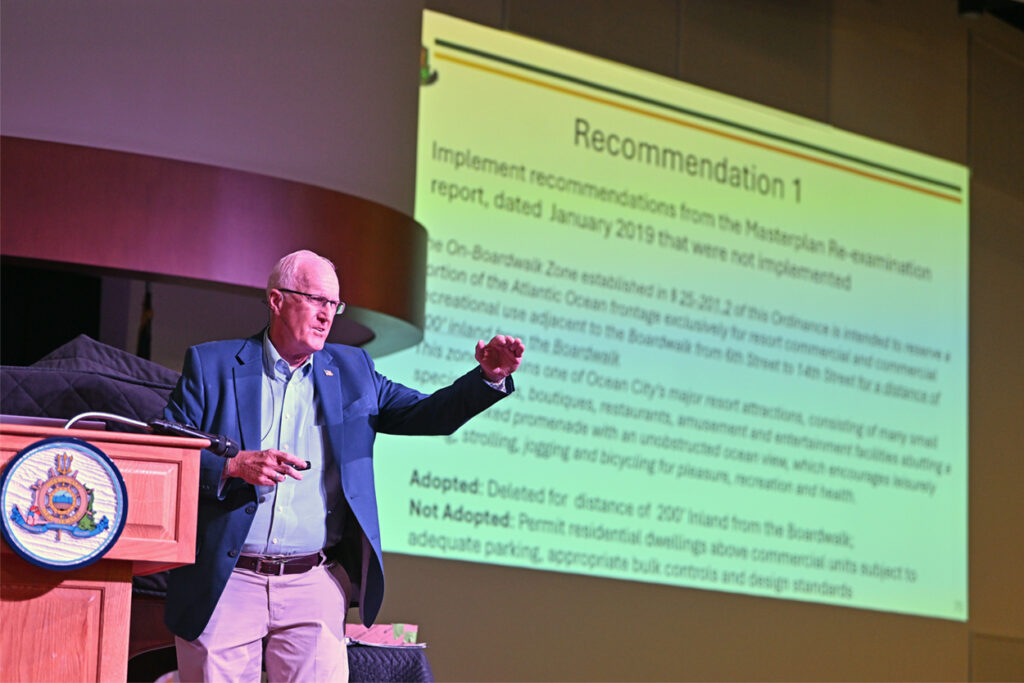
Subcommittee Chairman Dave Winslow, the Fourth Ward city councilman, handled most of the presentation, which was displayed in a series of slides on multiple screens at the Tabernacle.
The Boardwalk Subcommittee considers the 600 Boardwalk property a “once-in-a-generation” development opportunity that will require zoning reform to unlock its potential.
As Winslow said when getting to “the good part,” the data-driven recommendations near the end, he noted requirements about any hotel that would be built on the boardwalk: “We don’t want to decimate the neighborhood with a huge building.”
One of the major concerns from neighbors to 600 Boardwalk was that Mita’s hotel would destroy their neighborhood because of its size blocking light and air and the traffic it would generate.
“I think everyone that’s on the committee — and I can speak for City Council — wants what’s best for Ocean City, and we’re willing to work with the current owner or any future owners to deliver a best-in-class product for the boardwalk,” Crowley said after the presentation.
That means Mita’s public plan for his eight-story, 252-room hotel with 10-12 storefronts doesn’t fit?
“No, and I think he knows that to a certain extent. He’s a developer, right? So in any negotiation, if both sides leave unhappy, they say that’s a good negotiation,” Crowley said.
“I’ve seen him throughout this process. It’s going into two or three years, listening to feedback. I think he wants what’s best for Ocean City,” Crowley said. “And if he wants to come to the table and work with us to get to the spirit of what this report entails, then we’re more than willing to have that discussion.”
Mita wasn’t at the meeting. Contacted afterwards he said he was open to listening to other ideas about the property, but would have to wait before offering a detailed response to the report.
Asked if he would be willing to compromise on what he wants to build at 600 Boardwalk, Mita said, “As always, as I’ve done over the past five years, I would talk to everybody, anybody, any time, and listen. I’m always open to listening. If somebody has a better idea, I’m all ears,” he said. “No question about that.”
“I’m very interested to see the transcript and discuss it with the administration and with the people,” he added, noting he was on his way to a building project in Ireland.
Subcommittee member and City Councilman-elect Jim Kelly offered similar thoughts as Crowley. Before running for council, he helped lead groups that were fighting Mita’s hotel plan.
“We’re looking for compromise. If we’re going to have a new hotel in town and it’s going to be there, we’ve got to figure out like the right size, you’ve got to figure out the right placement,” Kelly said. “And we can’t give up on entertainment, right?”
He spoke about some of the major findings in the research and the recommendations, the need for more entertainment.
“Everybody who’s been involved in this study, including the boardwalk merchants, clearly (know) entertainment brings people to town. We might need to find the new entertainment,” Kelly said. He said he was talking to people about wave pools.
“I don’t know if a wave pool is the right idea, but I know we need new ideas,” he said. “We need to think out of the box, but we need entertainment. And if we’re only focused on if an amusement park doesn’t go there, no entertainment goes there, that’s wrong. We’ve got to get out of that thinking.”
Overall, Kelly said he was proud to have worked on the committee.
“Nine people volunteered their time, offered up their talents, their experiences. The nine of us don’t agree on everything, but we spent from November through June working together, sitting in a room, hashing things out.”
“I do think we’ve given City Council a … good dropping-off point,” he said.
Fellow member Sean Barnes, who was just re-elected in May as an at-large councilman, said he knew the people were “looking for a definitive answer about 600 Boardwalk, but that’s not what we were tasked with.
“We were tasked with giving a holistic look at the whole boardwalk, and I think we did that,” Barnes said. “This is just one more tool that hopefully City Council can use to make sure the boardwalk stays viable going forward as a really important part of our economy here and attraction for Ocean City.”
Victor Staniec, on the executive board of the citizen watchdog group Fairness in Taxes, was in the audience. He said the way the report was presented, it is going “to be impossible for Mita to build his seven-and-a-half-story hotel (seven floors with parking underneath) the way he proposed it.”
“They specifically said (any hotel) wasn’t going to affect the neighborhood, so that basically rules out what he had in mind. He’s going to definitely have to compromise if he wants to come up with something,” Staniec said. “And that’s the name of the game, compromise. And I’m all for compromising.”
Recommendations on 600 Boardwalk
The Boardwalk Subcommittee’s report had three pages specifically dealing with the former Wonderland property.
It said development there would consider adjoining neighbors “and not be overbearing to such a degree that it entirely changes the landscape of the area.”
According to the report, “the goal is for the property to serve as an anchor, and restore the economic ecosystem disrupted by the closure” of the Wonderland Pier amusement park.
“Just as important,” the report continues, “such a development shall not replace the spirit of the boardwalk, but rather reinforce and sustain it in a modern context.”
It recommends considering “conditional” mixed-used development there and at similar locations on the boardwalk.
It defines conditional use as something not permitted “by right” but would be allowed if it meets specific conditions in the zoning ordinances.
A decision on what would be allowed would be based on if it serves the public welfare and meets Master Plan consistency.
A “high-quality” resort at 600 Boardwalk would be integrated with frontage that preserves the character of the boardwalk, have upscale hotel rooms with amenities and specialty dining open to the public, event and banquet space and an upscale retail component.
It could have complementary uses to address unmet needs such as modern lodging, wedding and convention venues, family event spaces and amusement or experiential attractions.
“Every case is evaluated on its merits,” the report reads.
Summary
Because the report looked at the entire boardwalk, rather than just 600 Boardwalk, its summary reflects that.
“The On-Boardwalk Zone should not be considered a conventional zoning district, but rather as a unified destination experience,” the report reads. “Entertainment uses must serve as the primary driver of visitation, designed to curate the modern-day expectations.”
Next steps
The subcommittee will present its findings to City Council for review.
It recommends sending the report to its recently hired independent planner for review and sending it to the Planning Board and the city’s planner. The Planning Board, in turn, may provide recommendations to City Council.
Council, according to the subcommittee, “should consider Planning Board recommendations and the Boardwalk Subcommittee report in developing a long-term strategic plan for the future of the boardwalk.”
The other committee members are Third Ward Councilman Jody Levchuk, a boardwalk business owner; Michael Allegretto, representing the city administration; Dean Adams, a builder and Planning Board member; Shannon Halliday, an architect and Planning Board member; and Wes Kazmarck, a boardwalk business owner representing the Boardwalk Merchants Association.
After the presentation, Winslow said because people had other places to go on a Friday night, the committee members would stay to answer questions one-on-one as long as needed.
Background
Mayor Gillian, and his father, the late Roy Gillian before him, operated Wonderland Pier amusement park for nearly 60 years before Gillian announced in August 2024 he would close the park permanently in mid-October of that year because it was no longer financially viable.Gillian had sold the property to Mita in early 2021 when Mita stepped in to stop foreclosure on about $8 million in loans on the property. Wonderland had been in financial difficulties that were exacerbated by the COVID-19 pandemic.
Mita leased the park back to Gillian and he operated it for four more summers — 2021 through 2024.
Public concerns over the Wonderland site began because of Mita’s background as a luxury home builder and owner of multiple upscale hotels, most in Cape May County, as part of Icona Resorts.
Soon after Gillian’s announcement about the closure of the park, Mita announced his hotel plans. He has projected his investment would be in the range of $170 million.
Mita asked the city to declare the property “in need of rehabilitation,” a step he wanted to ease his path of placing a hotel in a zone limited to amusements. Several community groups arose in opposition to those plans. Council meetings for months were filled with people speaking against and in favor of Mita’s hotel proposal.
Back in August 2025, City Council voted against sending the property to the Planning Board to get its recommendation on whether the property qualified as being in need of rehabilitation. However, after more public pressure from boardwalk and downtown business groups that argued in favor of the hotel, and because of worries about declining business at the north end of the boardwalk with the amusement park closed, council reversed course late in the year. They asked planners to rule on a recommendation.
This past January, the Planning Board, in a meeting at the Ocean City Music Pier to accommodate the crowds and more than 75 people speaking during public comment, ended up in a tie vote. The board put forward no recommendation, leaving the site in limbo since then.
Editor’s note: An additional story from the Boardwalk Subcommittee report will be in the June 17 edition of the Sentinel.
– STORY and PHOTOS by DAVID NAHAN/Sentinel staff