
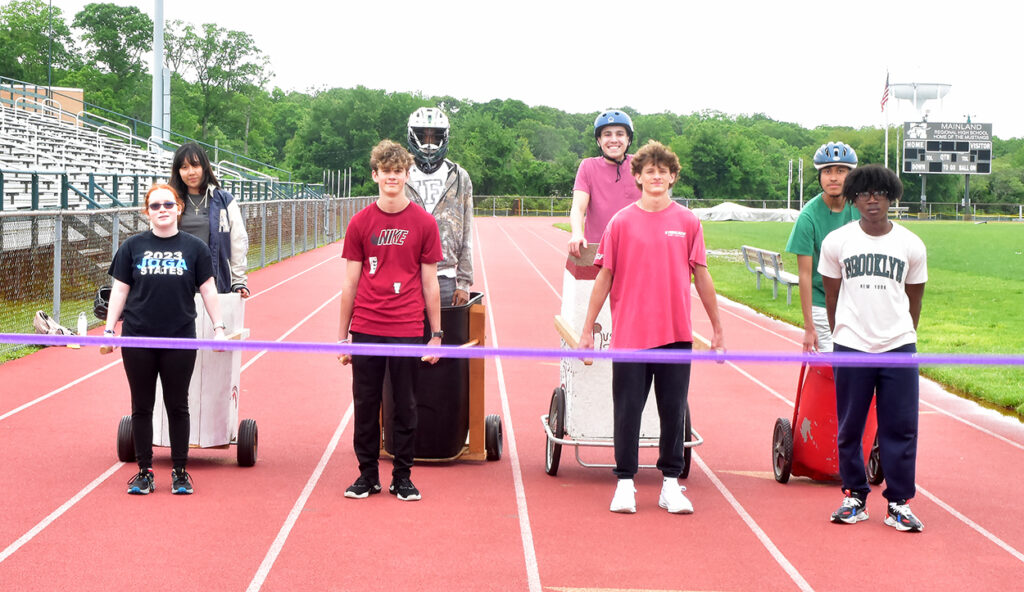
Latin students at chariot race contemplate end of program at Mainland Regional High School
LINWOOD — Comedy was mixed with tragedy May 29 when students in the Mainland Regional High School Latin classes and club held their annual chariot races on the track.
Youth known as Equi pull the conveyances, made by students and some years-old, while the Aurigae hold on for their lives with the glory of victory in their sights.
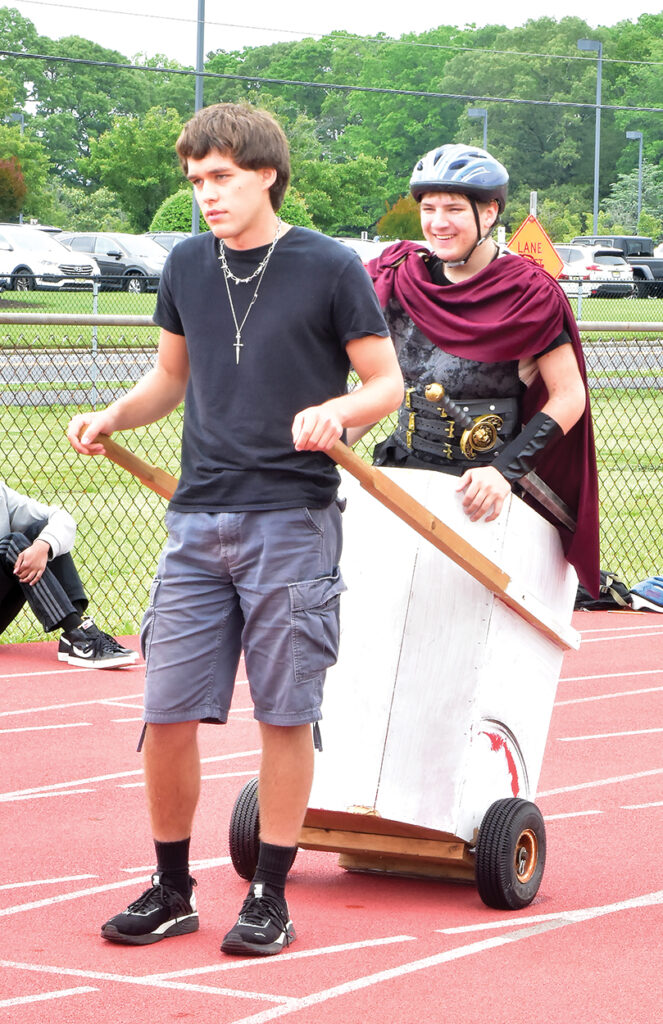
While students, at least one dressed as a centurion, let off some steam and enjoyed the camaraderie, some said they were saddened that the district has decided to sunset the Latin program.
Latin teacher Sarah Mench said she has been holding the races since 2003, noting that even during the COVID-19 shutdown, students filmed their own versions and shared them.
“People raced their dog or had their dogs race each other, or they raced friends in the neighborhood and posted the videos so people could watch them so that we could kind of have it in an attenuated form even though we were not together,” she said. “We kept it going for all of that time.”
Mench said one of the chariots, made by a student and her father, has been around since the very first race. She said many are left behind for future use.
Before the races, which are much safer than those held in the Coliseum in much less elaborate carts, Mench talks with the classes about the role of chariot racing in ancient Rome.
“It was the most popular sport,” she said, noting that she got the idea after watching a video made by a university professor who got people together, built chariots, trained horses and held an actual race. On it, various other scholars share their knowledge of the sport.
“They watch that and then we come and have our own,” she said. “Now they know a little about the sport and what made it dangerous and what made it exciting, and why people were interested in it and all the kinds of things they were not allowed to do such as sabotaging other chariots and things like that.”
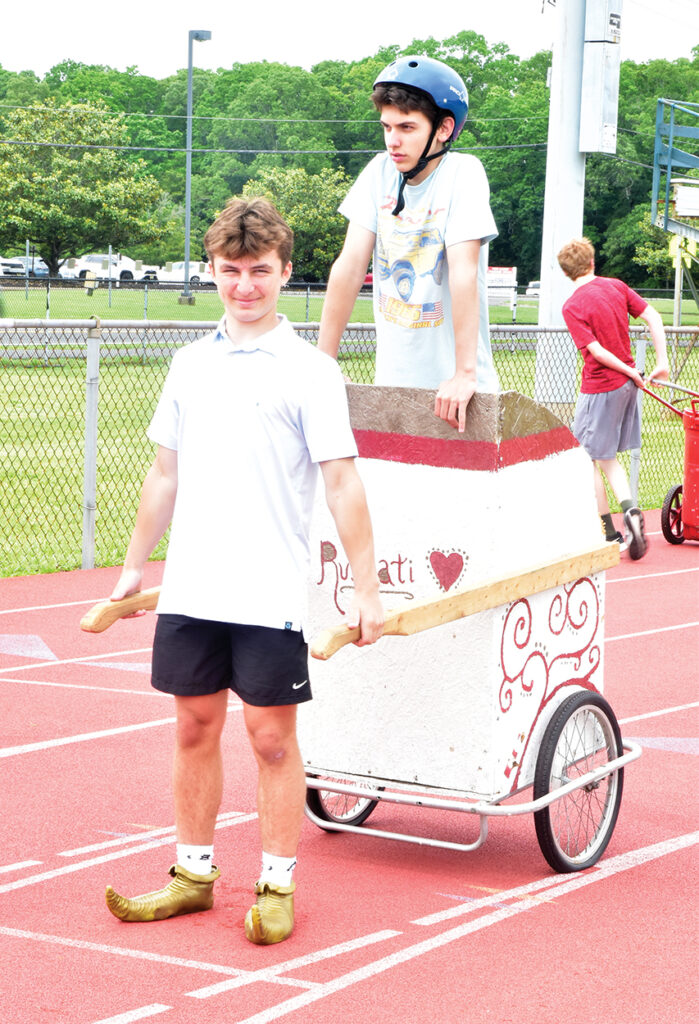
The races, which pitted 12 chariots each pulled by four horses against one another, were fast and dangerous, Mench said.
“You want to hug the turning point as closely as possible. The problem is, when you are trying to turn that you run the risk of crashing but if you move out to make the turn safer then someone a little more daring can zip in on the inside,” she said.
About 20 students took part in three heats of three or four teams, designated as russati, albati, veneti and prasini.
“We stay in lanes. This isn’t popular, but my No. 1 concern is safety. They would be happy with fouling, swords and all that other stuff,” Mench said. “I don’t want anyone going to the hospital, so we are a lot safer than the actual races. They have to wear helmets when they ride.”
She said the Romans didn’t wear helmets, their shoes were leather and the floor of the chariots was leather so there was not a good grip. Charioteers had to have a lot of strength.
“If you fall out of the chariot, you can be dragged by your horses, you could be trampled by other horses. Some people had the reins wrapped around their arms, and that’s why they carried a knife so that if they fell out they could try as they were being dragged along to cut loose,” Mench said.
While still slaves, she said the riders were treated as sports heroes and fed well because they were money-makers. They could earn money and even their freedom.
“That would be the goal of any slave. You know you are going to be fed because they want you strong, they aren’t going to beat you or mistreat you because they want you in good shape for the race,” she said.
Dressed as a gladiator, student Jack Traa, a junior from Linwood, said chariot races was the entertainment of the day.
“There was no TV, there was no radio. Everybody came to the games. Everybody came to see the races,” Traa said. “Gladiatorial fights are big in Hollywood but they were not as big as people think.”
He said that by the end of the Roman Empire, more than half of the year was set aside as holidays featuring tournament games.
“Early Roman Republic, once every other week, but more and more emperors kept adding dates, trying to curry favor with the populace, and it bankrupted the empire,” he said.
Traa enjoys both the language and culture of ancient Rome.
“Every Latin event, I am in a gladiator costume,” said Traa, who also is a member of the Drama Club.
He found the costume in a closet in Mench’s classroom, it fit well and he has worn it since freshman year.
“I love Latin and I love the group of people. I love Ms. Mench and I love the program,” he said.
Last month, when finalizing its budget, the district officially decided to sunset the Latin program based on lack of interest.
Data provided showed world language enrollment for 2024-25 includes 416 students in Spanish, 173 in Italian, 117 in French and 40 in Latin, including just 11 freshmen.
The Latin program will sunset over the next several years, allowing all current students to complete their sequence of courses. No new students will be enrolled.
Mench, who will transition into teaching English, said learning Latin is terrific for those seeking careers in law, science, medicine and other disciplines but has proved equally as influential with special education students who have reading or writing disabilities.
Traa, who is dyslexic, said his language skills have increased exponentially since he started taking Latin.
“Reading and writing were always difficult for me and that transferred over to Spanish in elementary school and middle school,” he said. “I started taking Latin in freshman year and within a year, my reading and writing skills had gone up. I got a perfect score on the reading and writing for my SAT.”
He said Latin is helpful for people with learning disabilities because 60 percent of the language comes from Latin, while the other 40 comes from German and Scandinavian and lesser so other languages.
“English is very, very deep-rooted in Latin. Learning Latin and learning the basics and learning how that language was formed has helped me learn not only English, but I’m starting to learn Italian, I’m starting to learn French, I’m starting to learn more and more Spanish,” Traa said. “Latin has really ignited a love for language.”
While he still struggles with writing, noting spelling is difficult, he has no problems reading.
“I just love reading now. Reading, since I started taking Latin, has become a passion,” Traa said.
He said he was “devastated” when he learned the school district planned to sunset the program. Traa said he spoke at two Board of Education meetings, wrote letters to politicians and wrote his college essay about the issue.
“This is the most intense battle of my life to try to keep this program,” Traa said. “It has helped me so much and the idea of it not being here is terrifying, especially with the other cuts they made to special ed. It’s devastating to all those people that are really going to struggle now because they won’t have that foundational part to our language. It’s just so hard to think that it’s not going to be here.”
Jill Panza, a junior from Northfield and member of the Latin Club, said she is disappointed that she will not be able to take Latin class, which she thinks would be useful in her future career in law enforcement.
“I find it interesting that not only is it the root of all romance languages but also has a lot of influence on English despite English being a Germanic language,” she said.
Panza said being in the club has made her realize how important Latin is as a language.
“Latin Club has really exposed me to the cultural and historical relevance, as well as its continued use in medicine, in law, in all the other hard sciences, humanities, theology,” she said. “For a class like gaming concepts to continue when Latin is being sunset is kind of absurd to me because while I’m sure gaming concepts is a good class, Mainland is a school, an educational facility. Why are they prioritizing a fun elective that keeps students’ minds occupied over an actually hugely beneficial course for those who have certain learning disabilities such as dyslexia or selective mutism or who are on the spectrum,” she said.
– STORY and PHOTOS by CRAIG D. SCHENCK/Sentinel staff