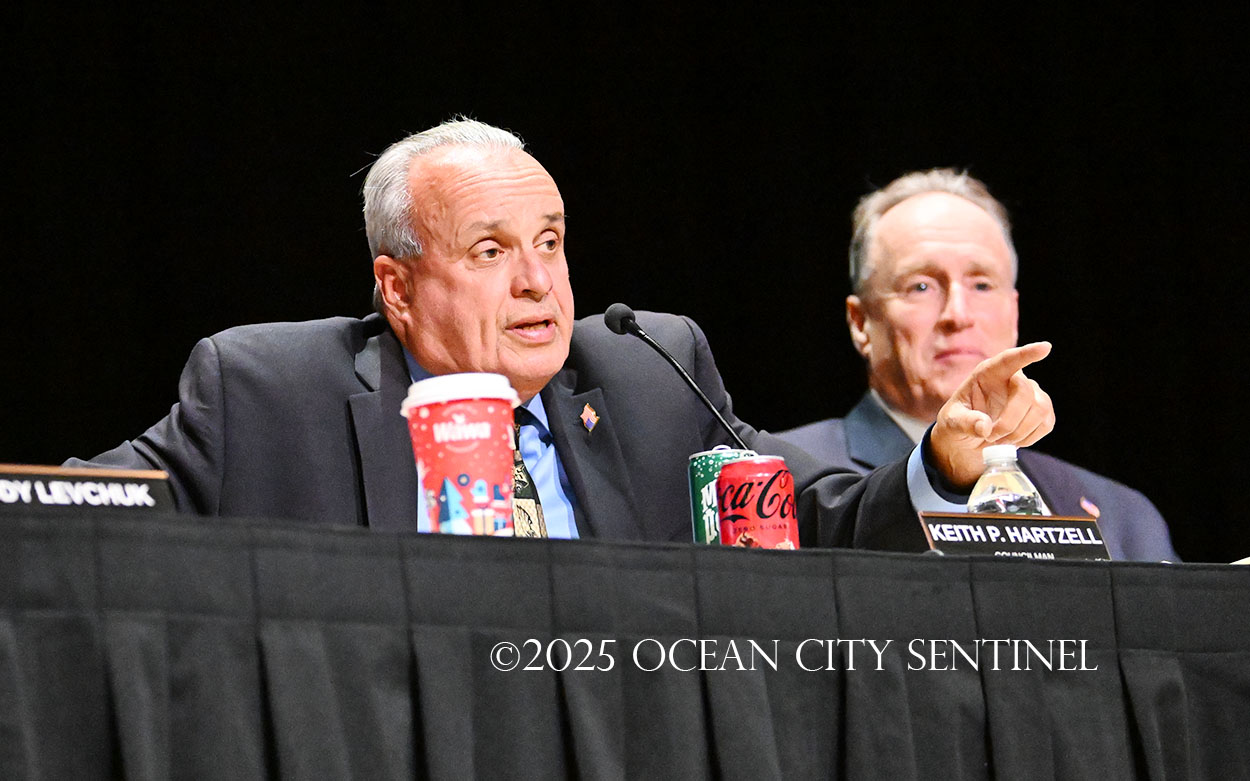
OCEAN CITY — Second Ward Councilman Keith Hartzell, who formally launched his campaign for mayor Feb. 25, took part in a question-and-answer session with the Sentinel before his formal announcement.
Answers have been edited for length.
What are the key things that are motivating you to challenge Jay Gillian for mayor again this year?
There are things that I’ve wanted to get done, and for whatever reason, they’re not getting done. The first time I ran, it was mainly about what was happening, seeing that this was going to happen.
The other thing was the sewerage (allowing Upper Township to tap into Ocean City’s treatment plant) and that stopped and the combined police station/fire station and that stopped. A lot of it had to do with vision. I think I used “clear and present danger” last time. So I look backward and I say, ‘OK, some things got done. Some things I didn’t win.’
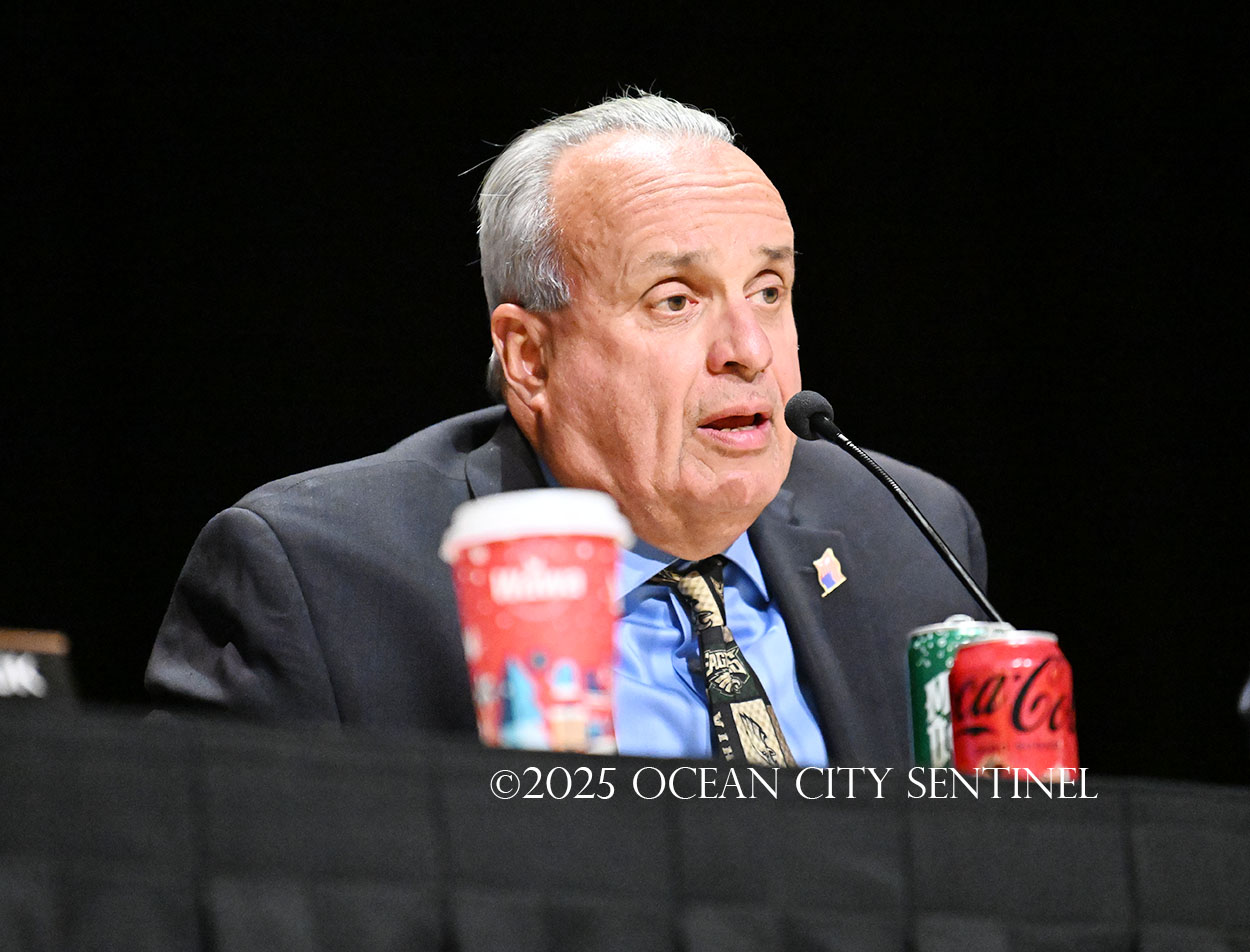
This time, I’m in the same position where I’m seeing things that I would like to accomplish and I’ll be able to accomplish them (as mayor).
In our government, generally, if the executive wants to do something, on council you support it or you don’t support it. The reason to become mayor is because there’s things that you want to do and you want to work them out with the council.
A lot of them are quality-of-life issues. I’m worried about what I see coming down the pike, which are homes that are going to be five-bedroom, five-bathroom, six-bedroom, six-bathroom that are generally going to be used as Airbnb rentals.
With costs so high, they’ll be rented by five different people and there’s nothing wrong with that, except that five cars are coming.
That’s why I started the September before last with the challenge of changing parking just in my ward because I thought it had the biggest need. It’s been a very slow process.
(For issues) I see quality of life and parking. That’s a huge issue that needs to be corrected for everybody because if we can’t park the cars, people aren’t going to come.
That’s also why I’m negotiating very heavily now with the pervious paver program to maximize the parking. I also want to make sure when a house comes down and a new one is built that it has adequate parking.
What would you say are your best accomplishments as a city councilman and what more you can accomplish as mayor?
I think the dumpster ordinance was a good one that we all came together on because that made total sense. We were able to get the yardage down from 30 to 20, get the dumpsters parked in front of the house (under construction).
You were the lone vote against last year’s budget with the 3.7-cent tax increase and noted how taxes increased 17 percent over the past three years. You lauded Councilman Dave Winslow’s approach to future spending. What do you want to see moving forward in the city’s budgets?
I voted against the budget last time because we went up 17 percent in three years. That’s a lot.
We have a $2.5 million surplus every year coming from the ratables going up and then we have the money from the library. (The Ocean City Free Public Library returns to the city a large part of the money raised by the dedicated taxes for libraries.)
I was one of the first people to talk about a penny (on the tax rate) for capital expenditures and then that the ratables would take care of the rest so that our tax increases would be one to two cents. We need to get back to that.
We should never solve a budget by another tax. We added the Airbnb tax. We have a spending problem, not a tax problem.
I’m never in a position where I want to do a new tax to solve a problem. I want to solve the problem. I look at the budget in many ways that we can just do better. And that’s what I’m going to do, to go through and look at everything that we’re doing. And is it a need or a want?
When I first got inaugurated (as a councilman), my dad leaned in and said, “spend the taxpayer money like it’s your own.” And that’s my guiding principle of how I’ve run my businesses.
I want to give the best experience possible, with the best service possible, for the least amount of money, and the most efficient way to do it.
Are there areas that you believe are ripe for reducing the city’s workforce?
I think that we need to do a very, very deep dive into how we’re doing things. A lot of it will come down to permanent part-time or use of permanent part-time and use of full-time. It will take time.
This is not something that’s a quick fix. We have to make sure that services are either maintained or improved, but look for more efficiency to do it. I may even have to bring some people in to help, to take a look at these things.
There shouldn’t be a hiring freeze, but we did institute a hiring freeze because we don’t think enough things were done before that (to keep costs down). I think that’s a macro way of doing it for now until I get in and move into a more micro situation. I don’t want any employees to think they’re doing a bad job because they’re not, and I don’t want employees to think they’re not going to have a job because they will.
I will never lay anybody off, but how we can do things better, get more out of people? Our employees are great, but we have to put them in the position to win. And that’s what a strong leader does. They know what they are doing, they’re doing a great job. But I really think that we can do some consolidation and some other training to get this accomplished so the budget could come down.
Much of the spending over the past 16 years has come through capital improvement budgets for projects such as the boardwalk replacement and flood mitigation. Are there any projects that you would have turned down and what limits would you put on capital improvements going forward?
It’s getting to that point where capital improvements are becoming less and less. I think we’ve gotten through the storm. (He pointed to proposed capital improvements for 2026 through 2030 presented to council Feb. 19.)
I said I wanted the new police station right where it is and now it’s going right where it is. We’ll go through that (capital plan) with a fine-tooth comb and make sure that everything we’re doing makes sense.
I was the first person to talk about flood mitigation. My father was the original engineer of using pumps, the first person ever to talk about it; he wrote a report about it. So the capital part’s very, very important to me.
I’m looking more at how we spend money on the labor end. And that’s what I’ll be focusing on, making sure that that’s as tight as possible.
Have you thought of any changes you would make in the administration itself were you to be elected mayor?
I think that’s a really hard thing to answer because it’s a personnel situation. My theory is, you go in and you evaluate everybody. And you give everybody a chance to prove their value, prove why they’re here.
And then you have a philosophy of what you want to bring across, which I’ll start to develop. Generally what I use is the old-fashioned strategic plan, and the strategic plan would basically be four goals. It’s about everybody buying the four goals and getting the goals done. My job as mayor is to cheerlead that. My management team’s job is to get it done.
It’s so hard to say I’m going to make these changes because you may find that you’ve got this great staff. It’s some minor things you need to do.
What project would be acceptable to you at the former Wonderland Pier amusement park site?
I think we all know that an amusement park’s not going to work there, but in my mind, the boardwalk can’t stop at Seventh Street.
The zoning for the boardwalk needs to stay on the front part of that property. Let’s say 100 to 125 feet into the property, I would envision more of a boutique hotel in the back.
When I look at the(Eustace Mita’s proposed 252-room hotel), it’s parking-deficient because it doesn’t account for more than one car per room plus employee parking for the hotel and stores.
If we zone the front part as it is today, I’ll actually go looking for people to come in and be a part of the experience. 7th Street Surf Shop is adding two new shops. They can’t wait to see what’s going to happen (at Wonderland), but say they can increase their brand in this block.
I’m going to look at that and say, ‘What other things might match that brand when there’s an empty store?’ I’m going to go try to find a tenant. I’ve done it downtown. It’s really about reimagining that end.
The problem is, there’s no short-term plan. The parking lot at Fifth Street is off 44 percent (in revenue) because we had no short-term plan (to make up for the draw of the amusement park).
We asked for it and it’s no, no, no, no. Obviously, I’m a big champion of the playground, but it could be something else (adjacent to the parking lot).
But the bottom line is, we’ve got a gold mine sitting there. We have this huge parking lot that is underused, with bathrooms. We’ve got to draw people down there and we can come together as a consensus.
Last night in the council meeting, a group’s been formed to do exactly that.
Let’s get a bandstand out there. Let’s get some entertainment there. We’re going to lose $250,000 approximately (in parking revenue) in that lot. We should be willing to spend some money to get that money back. We didn’t do that.
It needs to be solved immediately. First task, solve that.
Get action down there. Fill that parking lot. For instance, that lot doesn’t have overnight parking. I’ve got a huge parking problem in my ward. Is it the whole lot? No, but we should figure out if we should sell 30, 40 spots to get cars off the street.
If I was off 44 percent in my personal businesses, I’d fire myself.
You’ve long advocated for a community-built playground there in the north end of the business district, even offering to donate a property to help pay for it. Would you push for that again if elected mayor or are there other things you would like to see to help bring more people to that end of the boardwalk until something is built to replace Wonderland?
I would like to do the community-built playground. There are companies that do it. They come in and they help you raise the money and they help you put the playground together. So there’s no cost on the taxpayer’s back.
Obviously, I’d like to try that first. If not, then I’m willing to donate money as well. These playgrounds, they’re something else. They have them down in Florida and people drive 45 minutes to go to these things. They have splash pads. They have zip lines. They have jungle gyms. And what happens is the companies come in and they ask you what will work in your town, and then they customize it. It’s customized by the community. All this is done by the community.
Think of the excitement. You have all the news media down because the whole town has designed this thing and now they’re putting it together because they love people coming here and sharing this.
We’ve got this huge parking that’s underutilized, and we can bring people in and say thank you.
It will help the businesses nearby because after being at the playground the kids are going to want pizza, popcorn, all the things we’re famous for.
There’s other stuff that we could do but we should be doing something down there. There’s two reasons why people come to Ocean City — because it’s safe and it creates memories.
And their memory’s going to be “I got here and I got to go on all these neat things, and then I got something to eat and went on some rides. I want that special memory for that 7-year-old sitting in Richboro right now.
Putting something there like that is just a win-win to me.
It’s no secret you’ve been out campaigning for quite some time. Why did you wait until the end of February to make your formal announcement?
Politicians live in a bubble of the 300 or 400 or 500 people you know. When you’re strong-willed, people (in the bubble) will agree “that’s a great idea,” but they may or may not think so.
When you’re talking to people (outside the bubble), it’s not a matter of strong will. It’s the exact opposite. It’s a matter of listening. I start with an open-ended question and open-ended questions lead to conversation and conversations lead to consensus, compromise and growth.
And that’s what I look to do. And I wanted to make sure that the things that I was saying were hitting the right chord, talking about not enough parking with properties, talking about changing the parking in the downtown, and then looking at other places. And saying to people, you know, sometimes we put up with things because that’s just the way it’s been.
The town’s great. I love the town, but it makes sense to make it just a little bit nicer. It’s not like I’m making these big wholesale changes.
What I’m doing is some fine-tuning. That’s why it was so important to get out and talk to people first because it hones what I say.
It’s exhilarating when you realize that what you’re saying and what you’re talking about is connecting, not with everybody, but it’s connecting with a majority of people.
Some of those conversations at times can be difficult, but you’ll never grow if you don’t have them.
– By DAVID NAHAN/Sentinel staff