Advocacy group says commissioned census shows 78 percent would rather have family-friendly attractions and entertainment like it has proposed
OCEAN CITY — An independent poll commissioned by a local citizens group shows a majority of Ocean City residents are very or somewhat opposed to Eustace Mita’s proposal to build a 252-room hotel at the former Wonderland Pier amusement park site. The poll shows an even greater number would prefer a family-friendly alternative.
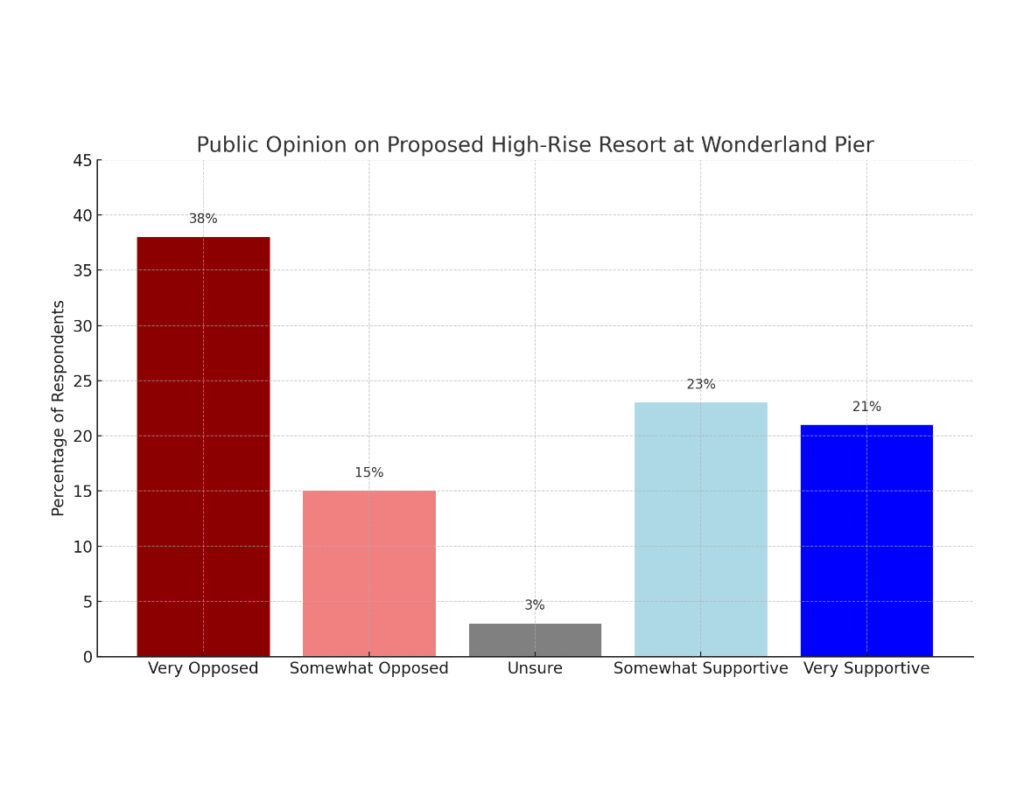
The numbers in the poll show 53 percent opposed — 38 percent very opposed and 15 percent somewhat opposed.
The poll shows 44 percent are supportive — 21 percent very supportive and 23 percent somewhat supportive — of a high-rise hotel.
The advocacy group Ocean City 2050 commissioned the “new, independent census” of Ocean City residents by the Eagleton Center for Public Interest Polling (ECPIP) at Rutgers University, the group announced Thursday afternoon, July 10.
“The findings highlight residents’ overwhelming support for Ocean City as a place to live, and deep community concerns that the potential high-rise development would fundamentally alter the character of Ocean City and create additional challenges related to parking, traffic and the local economy,” according to the group.
Mita’s plan includes the seven-story hotel with 10 to 12 storefronts and a few amusements — a carousel, Ferris wheel and jet boats that he took possession of when Wonderland Pier closed in October 2024 after nearly 60 years in business at Sixth Street and Boardwalk.
Current zoning does not allow high-rise hotels on the boardwalk.
Mita bought the property in early 2021 and leased the amusement park back to longtime owner Jay Gillian, who continued to operate Wonderland Pier for four more years until announcing in August 2024 the park would close permanently in the fall.
Mita has made multiple public presentations to show his vision for the site and answer questions, but has made no formal application. He said he plans to make a formal presentation to Ocean City Council some time in August.
A few different citizens groups have come out in opposition to a hotel on the property, including the advocacy group Ocean City 2050 and Friends of OCNJ History and Culture.
The census, Ocean City 2050 reported, “finds that a majority of residents oppose the proposed construction of a 252-room high-rise hotel on the boardwalk at the former site of Wonderland Pier, and a vast majority would instead prefer family-friendly attractions and entertainment.”
The public opinion research was conducted by Rutgers ECPIP as an independent third party. It was designed as a full census of Ocean City’s reachable registered voters, eliminating sampling error and offering a more accurate picture of local sentiment, according to Ocean City 2050.
According to the report, the majority of Ocean City residents oppose the 252-room resort being discussed for the boardwalk, with the results distributed as follows:
Although there is a mixture of support and opposition, both voiced at the various public presentations Mita has conducted, Ocean City 2050 says the poll shows a greater variance when those polled were given the choice between prioritizing more hotel lodging versus more family-friendly attractions and entertainment. In that instance, residents selected attractions by a large margin — 78 percent to 22 percent.
“This independent research was commissioned to better understand the wants and desires of the public. It reinforces what we’ve been hearing in our one-on-one and group meetings for months: there is deep love for Ocean City, but also that opposition to the high-rise hotel among residents is strong and widespread,” Jim Kelly, spokesman for Ocean City 2050, said in a press release announcing the polling results.
“Ocean City residents want thoughtful growth, with an emphasis on improving entertainment, dining and retail options that attract foot traffic and enhance the boardwalk experience for all ages — not large-scale hotel development that threatens its charm and function,” Kelly said. “Moreover, this research corroborates that many fear that declaring the site a redevelopment zone would set a precedent that could lead to similar high-rise hotels up and down the boardwalk, changing the very character of Ocean City.”
The group pointed to poll results that show “deep reservations about how the hotel would affect daily life and future development along the boardwalk, including:
— Increased parking demand (76 percent)
— Increased traffic congestion (71 percent)
— The hotel’s height and scale (70 percent)
And long-term consequences:
— A zoning exception could lead to changes to other businesses and establishments along the boardwalk (68 percent)
— Fewer family-friendly attractions on the boardwalk (61percent).
Other poll results, Ocean City 2050 reported, are concerns about potential economic impact on surrounding businesses (52 percent) and the possibility of alcohol being served at the hotel (56 percent).
Local ordinances prohibit the sale of alcohol in Ocean City, which has historically been a dry town. Voters overwhelmingly voted down the proposal for BYOB in more recent years.
Ocean City 2050 pointed to other results of what people want on the boardwalk, including retail shopping (73 percent), family-oriented entertainment such as mini-golf and arcades (71 percent); restaurant and cafe options (69 percent) and public spaces and arts (55 percent).
By comparison, lodging polled much lower with small-scale lodging at 32 percent and large hotels at 23 percent.
The group reported respondents noted how lodging fell well below other activities and venues.
It’s overwhelming:
O.C. the place to live
Ocean City 2050 said the census showed 94 percent of Ocean City residents believe it is an excellent or good place to live, with a caveat, however, about development.
The poll showed 58 percent believe Ocean City is going in the wrong direction when it comes to the trend of replacing smaller homes with larger homes — a trend that has been taking place for decades. The resort didn’t fare well when it comes to balancing historic preservation with development, getting only 11 percent seeing that as excellent and 30 percent as good, but with 33 percent rating it as fair and 21 percent as poor.
“These results point to a community that values its character, accessibility and sense of place, but is seeing that erode through over-development,” said Bill Merritt, another founder of Ocean City 2050.
“Residents are not against change — they just don’t want change to erase the city’s unique character. A high-rise resort on the Boardwalk would do just that,” Merritt said.
Ocean City 2050’s
Wonderland Commons
The advocacy group has pitched its own proposal — Wonderland Commons. (See related story online at ocnjsentinel.com.)
Ocean City 2050 said its idea for the Wonderland site includes a “revived but small amusement park; entertainment for mid- to late-teens; a mix of culinary choices from fine restaurants and a rotating lineup of food trucks; rooftop venues for relaxing and entertaining; and a small upscale lodging facility that fits the town’s character.
“With a family-friendly identity that respects scale, sunlight and neighbors, it creates a draw on the boardwalk’s northern end, while being flexible, fundable and faster to implement,” the group added.
“The Rutgers census confirms that Wonderland Commons offers a path that better reflects what Ocean City residents are looking for,” Merritt said. “As a modern, multi-use boardwalk village, it not only benefits the public, it benefits the developer as well, making it a true compromise that works for everyone.”
About the
Public Opinion Census
According to Ocean City 2050:
The census was conducted by The Eagleton Center for Public Interest Polling (ECPIP) at Rutgers, the state university of New Jersey, on behalf of Ocean City 2050. Respondents to the census reflect the population parameters of registered voters in Ocean City.
The census instrument was developed jointly by the client and ECPIP researchers, who received approval from the Rutgers Institutional Review Board to conduct the study.
All registered voters with cell numbers were recruited by text to an online survey conducted in June 2025. Recruitment by cell provided 65 percent coverage of the target population of adults as estimated by the registered voter base maintained by L2 Data. A second listed sample of Ocean City Consumers, also maintained by L2 Data, was used to recruit non-registered voters.
Participants were screened to ensure that they were residents of Ocean City. Eligible residents and registered voters were recruited by a landline phone if a cell phone was not available.
Additional details can be found on Ocean City 2050 at oceancity2050.org.
– By DAVID NAHAN/Sentinel staff