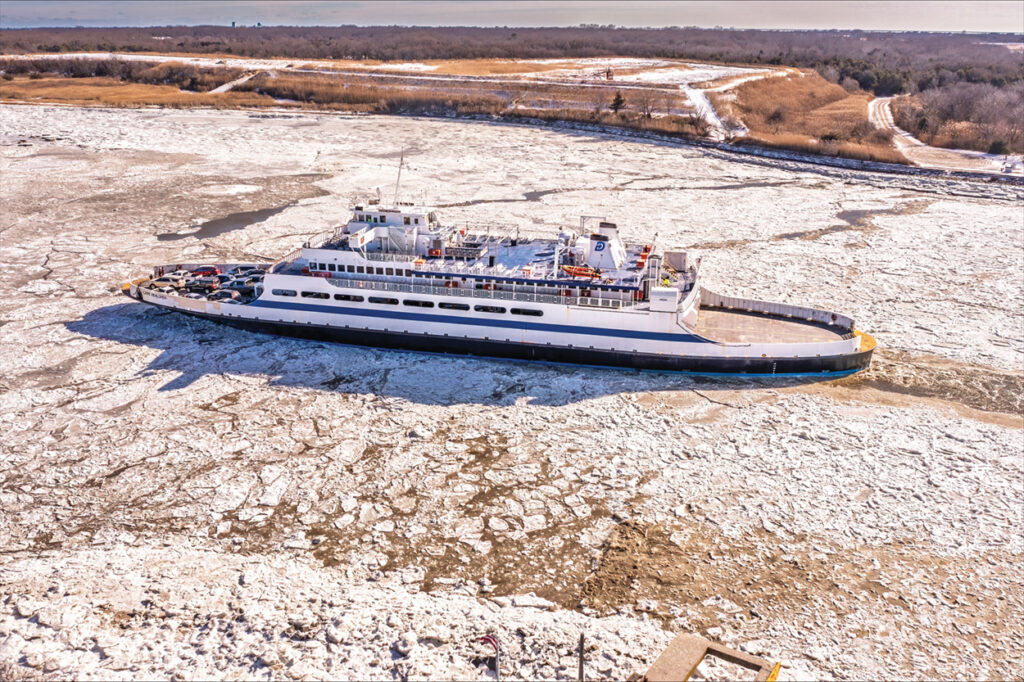
Cape May-Lewes Ferry cancels trips, continually monitors conditions
NORTH CAPE MAY — As winter weather wreaked havoc across New Jersey, the sustained frigid temperatures from the end of January through the beginning of February were ideal for the brackish waters of Delaware Bay to freeze over.
According to the National Oceanic and Atmospheric Administration, “ocean water freezes just like freshwater, but at lower temperatures. Fresh water freezes at 32 degrees Fahrenheit but seawater freezes at about 28.4 degrees Fahrenheit, because of the salt in it.”
These prolonged days of extreme cold weather disrupted the schedule of the Cape May-Lewes Ferry, canceling crossings due to impassable icy conditions in Delaware Bay.
Director of Ferry Operations Heath Gehrke said there are many variables the team must consider, including the weather forecast and potential lower temperatures, which might affect conditions on the bay.
“When the forecast is temperatures to be in the teens, we know that there’s going to be ice,” Gehrke said. “The tricky part is it sort of develops rapidly.”
On Jan. 31, the first round-trip sailings were able to cross the bay, but Gehrke said the ice filled in rapidly after the ferry’s departure.
“On the second round trip, we could get the ferry out, but judging on the tide conditions, we were afraid we won’t be able to get it back in, so we pulled the plug,” Gehrke said, adding that the conditions differed from the Cape May side of the bay to the Lewes, Del., side.
Gehrke said there was a little bit of difficulty getting into the dock in Lewes on Feb. 1.
“There just happens to be a tug in Lewes and that tug was breaking ice for the pilots, so it gave them a little push to get up into the dock,” he said. “That’s already a bit of a struggle, but it still seemed like we could get through the ice.”
On the return trip that day from Lewes to North Cape May, Gehrke said the tide was going out and the captain said they were pretty sure they could get out of the ice, but by the time she returned on another round trip, the ice would sink down with the tide and be packed tighter, and the pilot would not be able to get back into the dock.
Factors such as the quantity, consistency and firmness of the ice, as well as the tides, are all factors the team must take into consideration during the winter. Westerly winds can push ice into the Cape May Canal, affecting operations.
“The thickness of the ice is probably 4 or 5 inches, but it really makes a difference if it’s as hard as concrete or if it’s kind of slushy,” Gehrke said. “Then you can push through it, [but] when it’s hard, it packs and it won’t move aside.”
Temperatures increased slightly above freezing Feb. 3, which Gehrke said freed up the canal more than he expected, despite it being cold the day before. All departures were canceled that day and the morning departures were canceled Feb. 4.
“It’s hard to predict what’s going to happen,” he said. “We made a run over in the afternoon to see what it would be like to get into the dock and had some success.”
The ferry hired a tug the morning of Feb. 4 to break up the ice, which Gehrke said would allow them to operate until the weekend, when brutally cold temperatures were predicted and the slushy ice was expected to refreeze.
“It’s tricky to communicate clearly to the public what’s happening and it really does take some trials to figure it out,” Gehrke said. “The only other thing we could do is have tugs on both sides, but tugs are not cheap.”
For the operational team to tell what conditions they are dealing with, they need to push on the ice. Gehrke noted that breaking through the ice puts some wear and tear on the vessels.
“Last week [the crew] was coming in at 4 in the morning, a couple hours ahead of their shift, to see how solid the ice was and if we could break through it or not,” Gehrke said, adding that you cannot tell just from looking at the ice.
The crew can also see how far the ice extends from the mouth of the Cape May Canal. If the ice is out substantially through the canal, they know they will have to cancel crossings.
“What we’ve been trying to [do] in this period of uncertainty, we’ve been trying to pull the plug on trips we can cancel for the day and the first trip of the morning, because then it gives us some time to get in during the daylight, take a look, and do some pushing on the ice,” Gehrke said, adding if they cannot cross, they can give 2.5 hours’ notice to the people planning to travel that trip.
When crossings are canceled, information is updated on the ferry service website and on its social media, and the team contacts customers who have booked trips.
“We really appreciate everybody’s patience, and I know it’s not easy for people to understand the complexities of trying to determine whether we can run through the ice, with various wind and tide conditions,” Gehrke said. “We’re doing our best to get that word out as far in advance as we can, but sometimes conditions change rapidly.”
Gehrke added that Mother Nature sometimes does not cooperate, and it is unfortunate when people have already arrived and the trip is canceled.
“If people are booked, we contact them directly via text or calls when we know what is happening,” he said. “It’s helpful if people give us their cell phone number when they’re booking, so we can get a hold of them.”
Gehrke said the ferry service has not had much success preparing for winter conditions.
The ferries are equipped with boilers to heat the below-deck spaces, except for the MV New Jersey. Additionally, the pipes above deck have heat tape and insulation.
“The MV New Jersey is one of the two boats in Cape May and it’s been freezing up [with] frozen pipes, frozen water fills and vents,” Gehrke said. “The crew is busy trying to fix all of that right now.”
Even though the MV Cape Henlopen has a boiler, Gehrke said a specific drain line is frozen.
“Even with the heat tape and insulation, we can’t figure out why that pipe froze, but it impacts our food service,” he said.
– By RACHEL SHUBIN/For the Sentinel