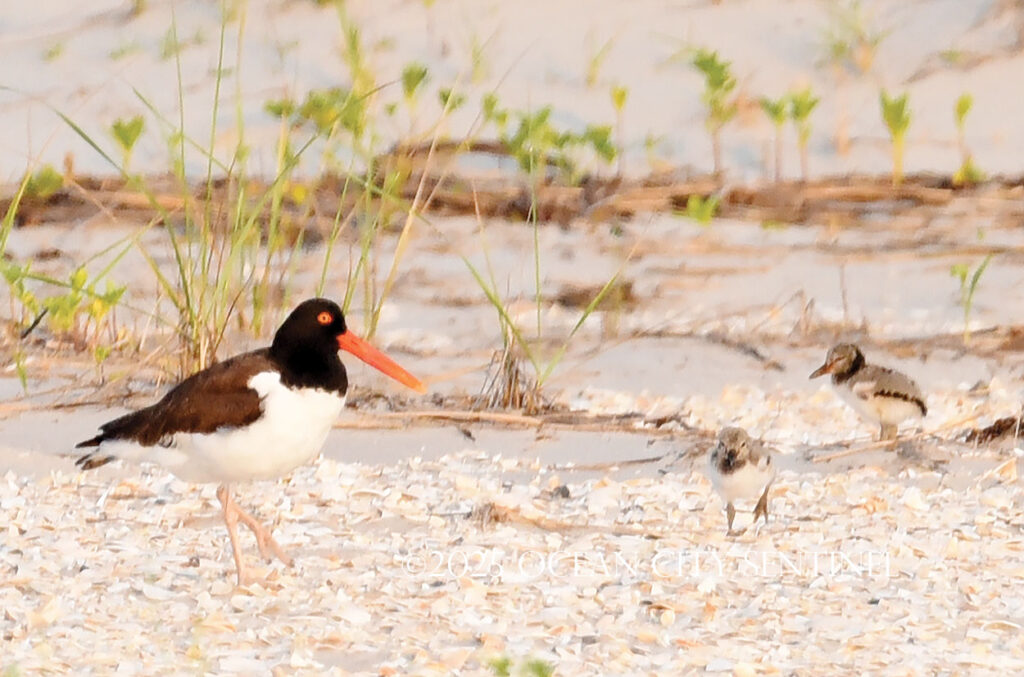
First oystercatchers fledged in Ocean City this summer
OCEAN CITY — For the first time, a pair of American oystercatcher chicks fledged in Ocean City.
A popular shorebird among watchers, American oystercatchers sport a long red bill, a chunky black and white body and yellow eyes. They are not an endangered species but are considered “a species of special concern.”
“That means that they don’t have the same level of concern as a threatened or endangered species, but it’s almost like a watch list. We don’t like where this is heading,” said Christina “Kashi” Davis, principal zoologist, New Jersey DEP Fish and Wildlife Endangered and Nongame Species Program in Woodbine.
That also means Fish and Wildlife is “going to try to intervene and prevent them from becoming threatened or endangered.” In terms of American oystercatchers, that is actually working. “We are pleased overall with the trend among oystercatchers in New Jersey and believe our management is working,” she added.
“We’re really proud of the work that everybody has done toward oystercatchers not only in the state, but for the entire region,” Davis said. She cited the American Oystercatcher Working Group (amoywg.org) that is a regional effort across the Eastern Seaboard with states working together to track and manage the population.
A pair of American oystercatchers was nesting among the dunes in the north end of Ocean City, a few blocks from a piping plover nest. (See related story on piping plovers.) Davis said it was the first time they fledged chicks in Ocean City. (That doesn’t mean all of Peck’s Island, which includes Ocean City and Corson’s Inlet State Park.)
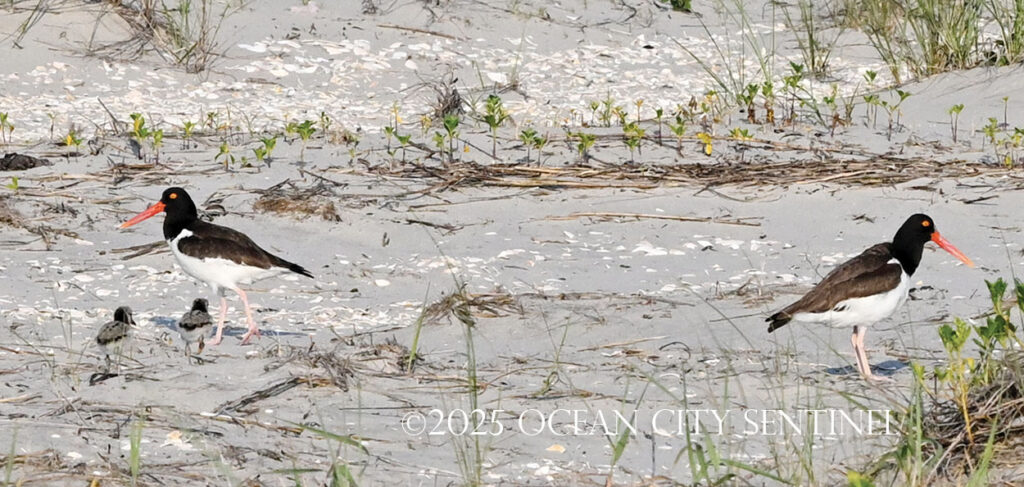
Oystercatchers are a little different from piping plovers in their challenges, Davis said. Unlike the tiny plover chicks, the oystercatchers are a much bigger bird.
“People adore them. They love oystercatchers. They’re very easy to see. They’re very unique-looking, they’re very funny to watch, so we typically get more public support for oystercatchers than we do piping plover on an average beach,” she explained.
Unlike plover chicks, oystercatcher chicks do not have to feed themselves so they can stay more within the confines of a fenced area, and they don’t have to waste energy running back and forth from the fenced areas protecting their nests to the wrack line on the beach to feed.
“They can conserve that energy and just take calories in, and that helps them grow a little faster and a little chunkier than our piping plover chicks can,” she said. Watching the parents with the chicks over the summer, one of the adults would fly away from the nest in the dunes and return with food for the chicks.
The oystercatchers also have a wider variety of habitat.
In New Jersey, piping plover will not nest anywhere but the beach.
“American oystercatchers will nest on the beach. They’ll nest in the marsh. We have some that are on rooftops in Atlantic City. We have them on the bayshore as well as the Atlantic Coast shoreline, which is not true for breeding piping plover,” Davis said.
That gives them more habitat, which works in their favor.
On the other hand, they have very little camouflage.
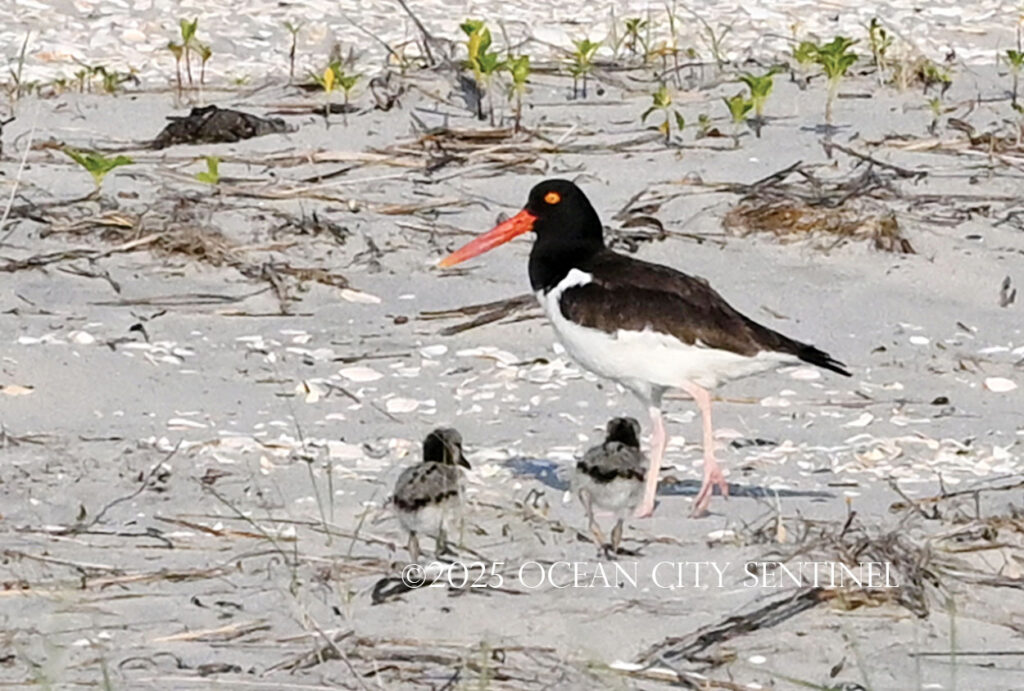
“Piping plover can essentially blend into the background. It is very hard for oystercatchers to hide,” she said. Their eggs are sand colored and camouflaged but on the bigger side.
“The adult itself can cue off predators, so our hatch rate of oystercatchers is often much lower than piping plover, same with their fledge rate, but they’re also a much longer-lived species. So where a piping plover in New Jersey may live five or six years on average, oystercatchers can easily live over 15 years,” Davis said.
They may not have as many chicks each year as the endangered piping plover, but they don’t have to hatch as many annually to maintain or grown the population, which is working to their advantage. Their reproductive goal is for 0.5 chicks per pair (versus 1.5 chicks for piping plovers).
The two oystercatcher chicks that hatched for the nesting pair in Ocean City survived.
“That was really exciting because those are the first oystercatchers that we’ve fledged in Ocean City. We’re really pleased for those two chicks to make it,” Davis said.
Cape May County
oystercatcher population
There is a good-sized population of American oystercatchers in Cape May County.
“We have many, many oystercatchers that are still nesting. I wouldn’t call them recovered or that we have no concerns, because the areas that they’re nesting in are highly susceptible to all these same risks” as those facing piping plover,” Davis said.
Fish and Wildlife is “extremely concerned” about the state’s piping plover population, but doesn’t believe the oystercatcher population is getting worse.
Year-round flock
While people don’t have to worry about disturbing American oystercatcher nests at this time of year, they will continue to see the birds.
“One thing that’s very interesting about the oystercatchers is they winter here, so we get really nice, good-sized flocks of wintering oystercatchers along all the inlets in the coast,” Davis said. “Ocean City north does host a flock of oystercatchers that will kind of bop between the North End, they’ll sometimes be over at the Seaview Harbor Marina (on Longport Boulevard), sometimes they’ll go over to Anchorage Poynte (in Somers Point), but there will be a flock of wintering oystercatchers through the season.”
Davis asked people to be mindful of the birds.
“Try not to let your dog run through them, to flush them. Just be respectful. They’re just trying to get through the winter here.”
– STORY and PHOTOS by DAVID NAHAN/Sentinel staff