
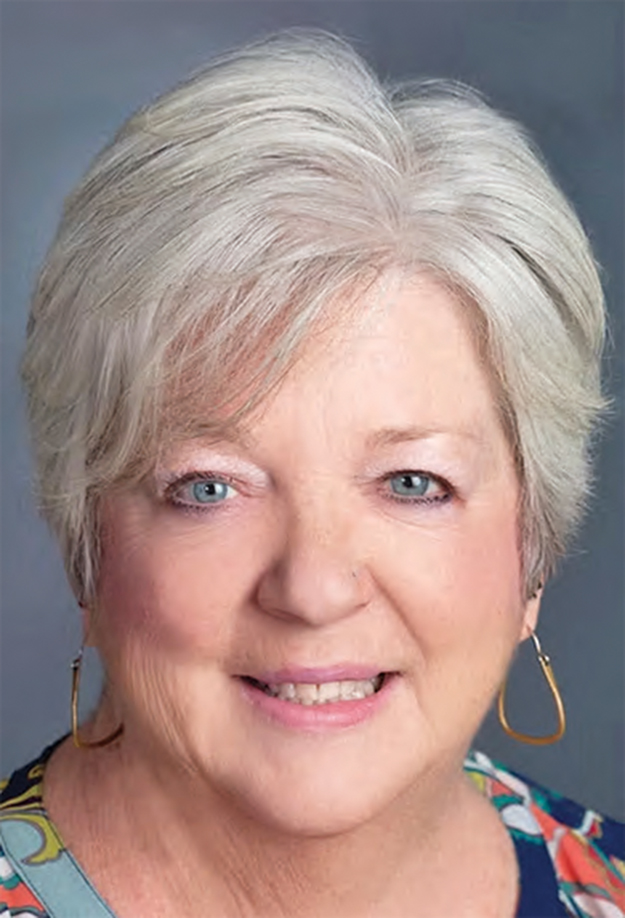
WEST CAPE MAY – Carol Sabo, 62, was born and raised in New Jersey and has lived for 38 years in West Cape May, where she currently serves as mayor.
She went to Gettysburg College in Pennsylvania, and then returned to New Jersey to attend graduate school at Rutgers University Camden, where she earned a master’s degree in social work.
“I always tell people it’s a natural segue for me to be in government. I don’t really talk about politics too much because there’s such a negative connotation to it, but I’m familiar with government because I work in government agencies, whether it was for the state or for our county special services through all my career.
“Advocacy is part of the work of a social worker. So that part of being in government is very natural for me, because that’s been part of my training and what I’ve done as a social worker and as a very strong union member.
“When I was working for the state, I was a member of Communication Workers of America, and then after I got my master’s, I got a job in the school district working with special needs students, and then was a member of New Jersey Education Association.
“So advocacy for the needs of children and families and also for workers and teachers and support professionals was a natural segue of what I did.”
What are your priorities if elected?
I’ve been in local government since 2013. When I was thinking about the direction that this country has gone in the last couple of years, I said now is the time to bring my skill set to Trenton.
My priorities are health care, education and the environment. All of which — a clean environment, a quality education and good health care, then you’re going to have a citizen, a person, a human being, who’s able to function to their maximum ability.
I’m concerned about the impact of a Republican governor, and if the Assembly were to switch, to the impact on education. We need to be prepared in New Jersey for the impact of what is happening in D.C., how it will impact New Jersey.
I am very much pro-education. I think that it is a function of the government to provide the best education for our children, and I don’t want to see someone in leadership who doesn’t share those same priorities. That’s probably the number one issue that got me to decide to become a candidate.
(After two terms in office, Gov. Phil Murphy cannot serve again, leaving the door open for a new governor. Democrat U.S. Rep. Mikie Sherrill is facing Republican Jack Ciattarelli. Democrats currently hold a 52-28 majority in the Assembly.)
The other issue is health care. Reproductive freedom, making choices about women’s health, doesn’t belong in the hands of male leaders in government. That is something that really concerns me. You’re hard pressed to think of a law of the land that affects men’s bodies.
And part of the environment is sustainable housing and safe and affordable housing. Those are the things that I believe should be a function of government, and I think that’s what differentiates me from others.
What are other big issues affecting Southern New Jersey?
The number one issue is affordability. I wish I could easily give you my answer to that. We’re in the process of a master plan review in West Cape May. We talk about prioritizing some worker housing, or, how do you incentivize commercial development versus this rampant residential development that we have and support small business when people just really want to put in another unit that’s going to make them a lot of money.
Affordability is absolutely a problem. We live in a county here that doesn’t want to acknowledge the homeless problem. We’re the only county in the state that doesn’t have a homeless shelter, and Atlantic City and Cumberland County don’t want to be the answer to our problems. But our county is very reluctant to acknowledge the problem and really invest in these people that need supportive and wrap-around services and housing.
“Housing First” is a model of supporting humans in our community so that they can then access the services they need. Some people are just living a paycheck away from being homeless or a decision by a landlord to sell their house and make it an Airbnb because it’s more profitable, and then they can’t find an affordable space. That’s definitely a more localized issue.
What can be done to address the high cost of living?
We have a unique position because you have to balance the impact of development. With rezoning, some people are talking about more infill buildings so that you can fit worker housing, or employee housing, and that may be more dense now in this area.
In Cape May County, that can be problematic because the density is creating issues for infrastructure. Either you’re a strain on the water system or you’re a strain on the roads and just congestion and the environment where people want to build.
And so you have to balance where you’re going to support this kind of building, and you need cooperation from surrounding communities where it might be more appropriate to develop some infill density.
So again, it would be stepping out of looking at the situation just locally from my West Cape May perspective, to zooming out and really looking at it from a regional perspective. How can we accommodate our community at large?
Cape May County suffers from seasonal unemployment, poor transportation infrastructure and a lack of industry. What can be done to improve the economic situation, which depends mostly on tourism? How can transit improve the local economy?
I’m old enough to remember a time when our congressman spoke of creating an industry and an economy in this area that didn’t focus on tourism, and back in the day, he actually supported wind energy — because of those manufacturing jobs and those tech jobs that could be brought into this county and for the region, manufacturing the turbines for wind energy.
There is room for an economy that includes something besides tourism. With the people that are here and serve in the tourism industry, those are people that need services, like doctors, accountants, attorneys, health care providers, all of the things that tourists like, but also for locals, like markets and gas stations and things.
I see it here in my local community too, some smaller businesses have decided to close because maybe they have a better opportunity, or it’s just too hard to make a living in this small window.
It’s a beautiful place to live and raise a family, but only if you have a job that can sustain you.
I was a social worker all my life; my husband’s a carpenter. I bought the last $100,000 house in West Cape May and that was in 1991, and that was a stretch for us at the time. We paid for that. But that’s not attainable for social workers and carpenters these days.
State transportation services need to change. We’ll never get the rail line over to my end of the world, because the rail bridges are destroyed at this point. But in terms of busing, schedules need to be expanded. They need to look at more micro transit, you know, smaller buses running more frequently.
Atlantic City Electric has implemented several big rate hikes this year. What plans do you have to assist the consumers? Is the answer more power plants? If not wind, what type of new energy-generating plant do you propose?
I want to make sure that everybody is aware of what assistance is out there in terms of energy assistance. I’ve actually run into some folks locally who didn’t realize that they qualified for some assistance, whether it’s income-based or otherwise.
My contacts at Atlantic City Electric and at the gas company have always said, if anybody is having a problem with their bill or paying their bills, they need to call and discuss what their options are.
And they actually do have programs that you can apply for. A lot of people aren’t aware that there’s any assistance involved at all. So I encourage anybody to just call their electric company and ask for that.
The distribution system seems to be where the rate increases are. Sitting with our representative from Atlantic City Electric, they’re not setting the rates themselves. They’re part of this larger conglomeration of corporations. It’s a complicated issue, and I don’t profess to have all the answers, but I did just get a notice that my bill is going up 128 percent next month. So I’m concerned, too, that’s for sure.
I really believe in a balanced approach to energy production. I believe clean nuclear power is not out of the question. I believe in wind energy. I believe in solar and making that available. Fossil fuels will always have a place in our energy system. I just think it needs to be more balanced, so that you have a system that can sustain itself and that isn’t so tenuous.
I wouldn’t rule anything out. With offshore wind, I just thought that whole issue was so politicized that they lost sight of how much good it could do. We’re blessed around here to have a lot of experts in the environmental field, and I asked about the impact. There would be some loss, but the wildlife would adapt. One good oil spill can have a lot of impact, too.
What do you think of the NJ REAL regulations? Do the changes recently proposed by the DEP change that opinion at all?
I truly feel that we can’t have our head in the sand about the impact of development along the coastline. Then we have a year where they won’t do any beach replenishment, because the federal government says that’s not a priority. So something has to give.
Whether or not they were too extreme to begin with, I think the intention is headed in the right direction. The guidelines are out there. They haven’t been approved or passed yet, so we’ll see what direction that goes.
Homelessness, drug abuse and mental health problems are prevalent in your district. What initiatives do you plan to address those issues?
The shelter is just one part of the resources that would be provided in that kind of space. Absolutely, you can have different levels of service being provided, whether it’s short-term housing, longer-term wrap-around services included in the model. There’s a lot of different approaches on how to do it, but really just feeling safe and secure and seven days in a hotel isn’t permanent housing.
That’s really what we provide here in Cape May County, at a very high cost. So, there’s other ways to do it that’s more affordable and provides better services.
– By J. CAV SCOTT/For the Sentinel