Operators: This isn’t regulation, it’s elimination
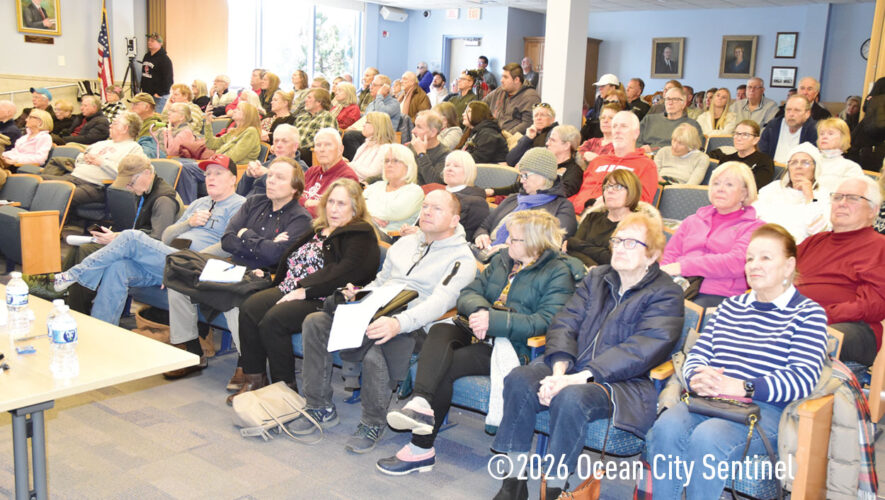
SOMERS POINT — City Council listened to a lot of passionate debate on both sides of the issue June 12 before voting 4-3 to extend the minimum stay at short-term rental properties from three to seven nights.
Those in favor of the amendment, including its sponsor Councilman Sean McGuigan, spoke of preserving neighborhoods, maintaining a strong sense of community and keeping the year-round population robust.
They complained of having new people coming and going multiple times each week, trash accumulating and problems parking near their homes.
The majority of those who spoke, however, spoke of the economic benefits of their rental homes, such as the 3 percent occupancy tax and $150 mercantile license fee the city collects, and the money spent in local restaurants, retail shops and other small businesse by guests.
The opponents, who said the change would cripple their businesses, also claimed their homes raise the standard of the community because owners fix them up and maintain them well in order to attract customers. They also noted the blood, sweat, tears and dollars they have invested in the properties, based on the knowledge that there was a three-day minimum.
The proponents
Before public comment, McGuigan said he wanted to let the public know why the issue was being considered now.
“Ever since this whole discussion of short-term rentals has been a topic, I continue to get input from my neighbors and citizens throughout the city. There’s always that input that ‘I want to preserve the neighborhoods,’” he said, noting he and his wife have lived in their home for 36 years, raising three children there.
“I can’t describe how great an experience that was, and to me the neighborhoods are the backbone of Somers Point. All the input I get is to try to preserve those neighborhoods for future generations,” McGuigan said.
“Is a seven-night minimum perfect? No, but it will reduce that rolling change of new faces in the neighborhood,” he said. “I’ve spoken to widows that look out and they have that uneasiness if there’s another set of visitors every week … and then there’s the younger families that maybe they hesitate letting their children play outside if there’s another set of visitors to our community,” McGuigan said. “That’s what my motivation was here.”
Michael Giannone said Somers Point is a family-oriented town and argued that families looking for year-round rentals cannot find them because of short-term rental properties.
Jim Oswald said he is not looking at the economics but the quality of life.
“I live here year-round and I support the local businesses during the slow season,” he said. “I live here and I vote here.”
Oswald said short-term rentals do not belong in residential neighborhoods and that they put stress on the infrastructure, police and public works departments.
He said a three-night minimum equates to as many as 10 turnarounds a month. With an average of six guests per stay, that’s a possible 60 new neighbors each month. He said there are six short-term rentals in his immediate neighborhood, equating to as many as 360 new neighbors per month.
“Know your neighbors is a central theme in our community and we all look out for one another. … even 50 new neighbors per unit per month is a little bit overwhelming,” he said.
Harry Kent said he moved to the city to live in a neighborhood and know his neighbors. He said there is a short-term rental on his street and there is trash present all the time.
Nick Wagner, a city police officer who also sits on the Board of Education and oversees the Police Athletic and Activities League, said he was speaking only as a resident.
He said short-term rentals are partially to blame for the continued drop in school enrollment, resulting in state aid cuts that are harming the district. He said that also affects Mainland Regional High School enrollment and aid, further costing taxpayers.
He said the future of the city depends on good neighborhoods.
“Should there by Airbnbs in some of them? I would say probably. There are people who come for boating, for fishing, for the restaurants. The west side of New Road, which is almost 100 percent residential, should have zero Airbnbs,” he said.
Professional planner John Helbig said the city has to decide what type of community it wants.
“Airbnbs dramatically change a community. We go from a community of residents to short-term rental properties, essentially accommodating tourists. That is a big change,” he said.
He suggested a cap on the number and allowing them only in certain areas, because he believes they are not appropriate in some locations.
The opponents
Speaking for the Somers Point Hosts and Residents Coalition, a group that formed in opposition to the amendment, Joe Brozetti of Dawes Avenue asked council to table the issue or reject it.
“This ordinance goes beyond reasonable regulation, it effectively shuts the door on a large portion of visitors and homeowners,” Brozetti said.
Longtime Somers Point resident Dan Myers said he and his wife have operated a short-term rental for five years and never had a complaint from neighbors. He said the experience has been fantastic and that they have met people from all over the world.
“We contributed greatly to the economy of Somers Point by bringing in people that spent tons of money because we don’t provide food, they go out and eat,” Myers said. “I think three days with the penalties you guys have written into the law is perfect.”
Tim Schwartz, owner of Summer’s Breeze on Higbee Avenue, said he uses Airbnb to book stays. He says there are age restrictions and that they reject anyone without a five-star rating.
“This creates a scenario for mutual respect between the homeowner and the renter,” Schwartz said.
He said one council member stated in an email that short-term rentals cause parking issues.
“I respectfully conclude that three or four days of parking is less than seven days of parking,” Schwartz said.
He said another council member mentioned that short-term rentals should not be in the residential zone.
“If you look at the zoning map of Somers Point, you will find most of it is residential. All around the waterfront, it’s residential. So, let’s be honest. The restaurants and bars are right in the middle of the residential zones,” he said. “We have entertainment in the summertime every Friday on the beach right in the residential zone. We have block parties in the street right in the residential zone.”
Economic Development Advisory Commission Chairman Rob Hopkins, delivering the second-quarter report, said EDAC voted against the measure.
“After a thoughtful discussion in a two-hour meeting, we did vote to recommend that no changes were made to the existing ordinance,” he said. “We believe the proposed change would negatively affect a variety of businesses throughout town and would run counter to our broader goals of economic growth.”
Hopkins said the initial ordinance was developed through an EDAC subcommittee in conjunction with the police department and code enforcement officials.
A member of the owners coalition, Nick Hresko-Staab said he grew up in this area and his family remains here. The Mainland Regional High School graduate who now lives in Bloomfield said he wanted to get a place where he grew up and found the only way possible was to rent short-term.
“If this proposal is adopted, it will undoubtedly have a negative impact economically and force homeowners to sell their homes, including us,” he said.
Hresko-Staab said he spoke with a lot of council members and was told the goal is to preserve the community.
“I also want to protect the community. I love being here,” he said.
He urged City Council to work with his coalition on a solution.
“There is no reason to rush the vote. Take time to consider this amendment, consider new ideas and come to a balanced solution that addresses everyone’s concerns,” he said.
He suggested alternative ideas such as a three-night minimum only once in seven days, grandfathering the existing rentals or treating it like a liquor license that can be sold and transferred.
“I don’t know what your goals are but we would love to be part of them and help you, help us and help all the citizens,” he said.
Catherine Powers identified herself as a short-term rental host and member of the coalition.
“While I fully understand concerns about neighborhood disruptions, I believe our existing three-night minimum strikes a thoughtful balance — discouraging party houses while accommodating responsible guests like military families in transition, health care workers, tradespeople and vacationing families,” she said. “The city has already implemented a robust enforcement system, including fines for sustained complaints and license revocation for repeat offenders.”
Powers said the change would eliminate 97 percent of current stays, gutting local bookings, slashing occupancy tax revenues and reducing spending at restaurants, shops and seasonal businesses that rely heavily on tourism.
“This doesn’t just affect hosts; it affects employees, service providers and the very businesses that sponsor local youth sports teams and community events,” she said.
Mike Halpern, an Upper Township resident, owner of Ocean City Winery and short-term rental operator, said he and his wife booked 187 nights in the past 15 months, 32.7 percent occupancy. He said that works out to $337 per night and a total revenue of $63,000. Of that, he said, about $10,000 goes out in taxes and fees to the city and state.
Halpern said the city collects 3 percent, about $1,900, while the state takes 5 percent, or about $3,200, in occupancy tax and 6.635 percent in sales taxes, or about $4,000. He said if short-term rentals were eliminated, the city and state would lose that revenue. Halpern said if there are 60 short-term rentals, that loss would equate to $553,000 to $600,000.
Lindsey Hresko-Staab said she was so excited to be able to buy a home in town.
“Buying a home in Somers Point truly was a dream realized for me and my family, who are lifelong residents of Atlantic County,” she said, adding her family invested their life savings in the home.
She said the change is not just to policy but would affect the livelihood of the business community.
“We are families, individuals, local entrepreneurs that have invested in to this town, not just with our money but with our time, our energy and our passion. We create jobs, we support local businesses and we bring visitors who spend money into this town,” Lindsey Hresko-Staab said. “The proposed seven-night minimum is not regulation, it is elimination.”
City resident Bob Bender said he and his wife Lisa, a former City Council candidate, spent months fixing up their property as a short-term rental. He said the majority of such properties are in better shape than their neighbors because the owners have fixed them up and maintain them well to attract clients. He said it is not fair to the people who have invested in the homes to take the revenue away.
“In Somers Point here, we want people to come to Good Old Days, we want people to come to Bayfest, we want people to come to the car show. Are you going to rent for a week? No, you want to rent for a couple days. You stay the weekend, you spend your money in town. That’s what this should be,” Bender said.
City Council candidate Levi Fox, who noted he had secured a position on the ballot through write-in votes in the primary election and would be challenging McGuigan in November, said the delayed implementation unt Dec. 31 provides the opportunity to study the issue and research effects on different neighborhoods
“I hope there is some place for collaboration,” he said.
Councilman Howard Dill offered to sit on a committee to research the topic, saying he owned rental properties when the rules were enacted in 2023 but no longer does, removing any conflict of interest.
“I am willing to work with the coalition in trying to come up with something that’s reasonable and acceptable to everyone,” Dill said.
Councilwoman Janice Johnston, who was council president at the time, said the issue had been thoroughly researched and it was decided that three nights was the right balance.
“Two years ago, under my leadership, we formed a committee of residents, business owners and council members to research extensively the issue of short-term rentals. We took the issue to EDAC, and that board did extensive research of their own in conjunction with the police department and construction office and had several extensive discussions with council.
“We sought the advice of city professionals, our redevelopment attorney, our administrator, our city engineer. We had several public discussions before any decisions were made. Everyone had a voice,” she said.
Johnston said there were complaints when there were no rules for short-term rentals, but “since we made the changes based on facts, not personal opinion, there have been little to no issues.”
“The fact is the city has benefitted financially on inspection fees, mercantile fees and a 3 percent tax. Businesses have directly benefited financially from these rentals. The estimate is that this industry has brought over $600,000 last year in revenue to our businesses,” Johnston said.
She said short-term rentals have always been part of Somers Point, “we just didn’t have a name for them.”
– By CRAIG D. SCHENCK/Sentinel staff